


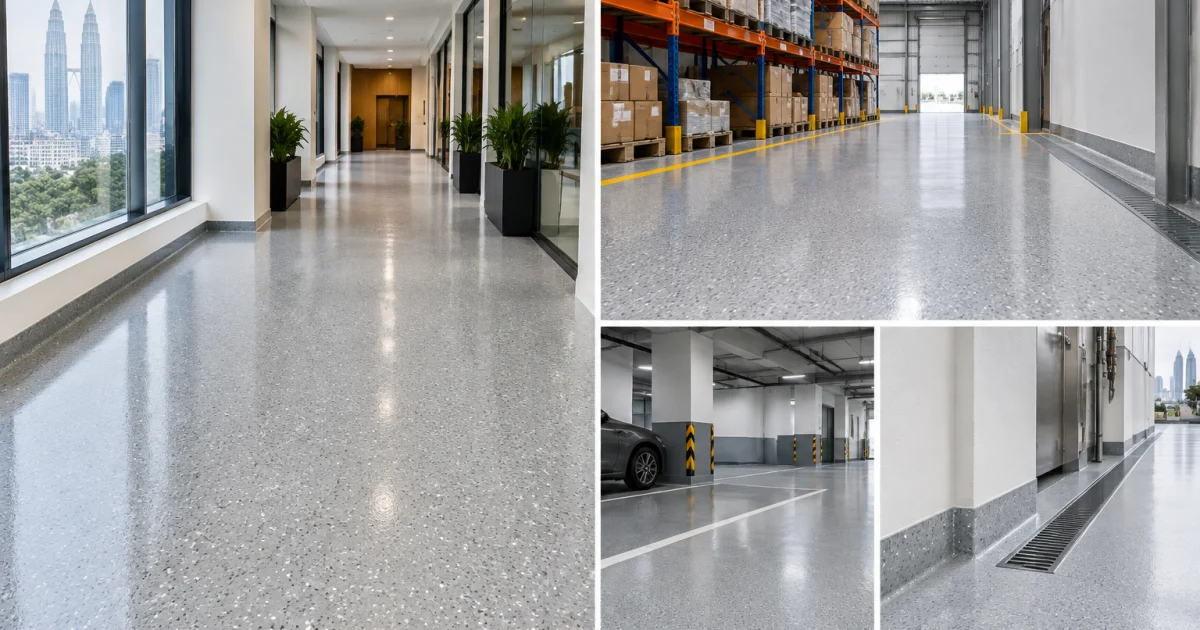
Epoxy Flake Coating in Kuala Lumpur: Beginner’s Guide to Choosing the Right System for Toilets, Kitchens, Warehouses, and Car Parks
Epoxy flake flooring can look straightforward: broadcast decorative flakes into epoxy, then seal for a clean, durable finish. In practice, two “similar-looking” floors can perform very differently depending on base condition, moisture, surface profile, system thickness, and topcoat chemistry—especially in Kuala Lumpur’s humid climate and wet-cleaned areas.
This beginner guide is for homeowners, F&B operators, warehouse operators, and building managers who want a contractor-ready overview before a site visit and quotation. If you’re searching for Epoxy flake coating Kuala Lumpur, use this as a checklist to specify the right system and avoid common failures like peeling, bubbling, slipperiness, and early wear.
What epoxy flake coating is (and what it is not)
Epoxy flake coating is a resin flooring system where coloured vinyl flakes (chips) are broadcast onto a wet epoxy basecoat. After curing, loose flakes are removed and the surface is sealed with one or more clear topcoats. The finish is seamless-looking, can provide controlled texture for slip resistance, and is easier to clean than porous cement.
What it is not:
- Not “just paint”: performance depends on correct mixing, curing, and adhesion to properly prepared concrete.
- Not automatically waterproofing: it resists water but doesn’t replace waterproofing details at joints, upturns, penetrations, and movement points.
- Not one standard thickness: builds range from thin decorative coatings to thicker, traffic-capable systems.
- Not a fix for wet slabs: moisture vapor or hydrostatic pressure can blister or debond epoxy unless the right primer/moisture strategy is used.
In toilets, kitchens, corridors, and many commercial spaces in KL, success comes from matching the system to the environment—not choosing by appearance alone.
Beginner terms you must understand before comparing quotations
Different contractors may quote similar-looking finishes with very different specs. These terms help you compare “apples to apples.”
System build-up (layers)
A typical epoxy flake system includes:
- Surface preparation: grinding or other mechanical prep to remove laitance, old coatings, and contaminants, and to open the concrete for bonding.
- Primer: improves adhesion and reduces pinholes; some primers are formulated for damp substrates.
- Basecoat: epoxy layer that receives the flakes.
- Flake broadcast: partial or full broadcast depending on look and texture needs.
- Scrape/vacuum: remove loose flakes and knock down high points.
- Topcoat(s): clear coats that largely determine gloss, wear resistance, chemical resistance, UV stability (where relevant), and cleanability.
Partial vs full broadcast
Partial broadcast uses fewer flakes for a lighter decorative effect and typically a smoother feel. Full broadcast covers the basecoat “to refusal” for more uniform coverage and often more consistent texture (final slip depends on scraping and topcoat choice).
Slip resistance
“Non-slip” must match the area:
- Toilets and wet corridors: higher traction improves safety, but overly rough surfaces can trap dirt and slow mopping.
- Kitchens: traction under oil and water plus cleanability are both critical.
- Warehouses: smooth rolling for pallet jacks/forklifts; too much texture increases wear and rolling resistance.
- Car parks: tyre grip and wet traction matter, with movement and temperature swings.
Thickness and “self-levelling” language
Quotes may say “self-levelling epoxy,” “epoxy coating,” or “epoxy flake.” A flake system can sit on a self-levelling layer (to correct unevenness), or it can be a thinner coating that follows the existing profile. If you have undulations, ponding, or rough patching, confirm whether levelling is included.
Topcoat type (epoxy vs polyurethane vs polyaspartic)
Many systems use an epoxy base and a clear topcoat. The topcoat chemistry affects:
- Abrasion/scratch resistance (warehouses, car parks)
- Chemical resistance (detergents, degreasers, mild acids in kitchens)
- UV stability (epoxy can yellow in sunlight)
- Downtime and return-to-service schedule
Where epoxy flake systems work best in KL properties (and where to be cautious)
Epoxy flake flooring balances appearance and practicality, but each area has different stress factors.
Toilets and bathrooms (residential and commercial)
- Drain detailing: terminations around floor traps/drains must be neat to prevent edge lifting.
- Slip resistance: choose wet-safe texture without creating a dirt trap.
- Movement joints/cracks: ignoring them can lead to reflective cracking and water entry at edges.
Caution: If underlying waterproofing or plumbing is failing, a coating can hide symptoms while damage spreads. Moisture checks and leak diagnosis may be needed before finishing works.
Kitchens (especially F&B)
- Cleanability: overly rough profiles collect grease and slow cleaning.
- Chemical/stain resistance: specify topcoats suitable for degreasers and frequent scrubbing.
- Coving/upturns (where required): helps hygiene and reduces water ingress at wall-floor junctions.
Caution: Regular hot washing can cause thermal shock. Ask how the system handles temperature swings and what cleaning routine is recommended.
Warehouses and logistics areas
- Abrasion/impact resistance: forklift turning, pallet dragging, and point loads drive wear.
- Adhesion on older slabs: oil contamination is common and must be addressed.
- Flatness and smooth rolling: excessive texture can increase resistance and reduce durability.
Caution: Rising damp or high moisture vapor can cause debonding. Prior blistering in older coatings is a strong warning sign to handle moisture up front.
Car parks (ramps, drive lanes, parking bays)
- Tyre hot pickup resistance: softer coatings can be pulled by tyres.
- Movement joints/cracks: need appropriate joint systems; don’t simply coat over active joints.
- Drainage and ponding: ramps/low points require attention to slope and water management.
Caution: If the deck needs waterproofing (e.g., above occupied space), decorative flakes alone may be insufficient. Car parks often need traffic-rated protective systems designed for movement and exposure.
Choosing the right epoxy flake system by area: contractor-ready recommendations
These targets help you communicate requirements clearly. Final specifications still depend on the site assessment.
1) Toilets: prioritise grip, hygiene, and edge detailing
- Goal: wet-safe traction, easy cleaning, reliable detailing around drains and junctions.
- System direction: controlled-texture flake system sealed with a cleanable topcoat.
- Detailing to specify: proper termination at floor traps, sealing at pipe penetrations, attention at thresholds and wall-floor junctions.
Example: If old tiles had grout staining or seepage at a doorway, the contractor should check slopes and thresholds, treat cracks, then propose a sealed finish that doesn’t become a dirt trap.
2) Kitchens: balance traction and cleanability
- Goal: safe under oil/water, resistant to detergents, practical to mop and degrease daily.
- System direction: stronger chemical/abrasion topcoat; consider cove detailing for wet zones and wash areas.
- Operational planning: align installation with downtime; consider staged works for operating kitchens.
Example: For slippery tiles near a sink, specify texture that improves grip while keeping the surface tight enough for efficient degreasing.
3) Warehouses: focus on mechanical durability and smooth wheel traffic
- Goal: reduce dusting, withstand wear, and support smooth equipment movement.
- System direction: robust base with a smoother sealed finish; use flakes selectively (walkways/marked zones) if desired.
- Substrate assessment: check oil contamination, weak concrete, existing coatings, and moisture vapor risk.
Example: A good proposal may use flake in pedestrian lanes for visibility and slip control while specifying a more abrasion-focused coating for forklift routes—using compatible primers/topcoats across zones.
4) Car parks: treat it as a traffic surface, not just a decorative floor
- Goal: resist tyre wear, reduce staining, tolerate water and movement.
- System direction: traffic-rated approach; flakes may suit bays/walkways, while ramps may need different texture and build.
- Joint/crack strategy: define how cracks and joints are treated; don’t bridge active movement joints with rigid coating.
Example: If there’s ponding near drains and hairline cracks, address drainage/slope and crack movement before selecting textures and systems for drive lanes versus bays.
Surface preparation: the biggest factor behind peeling, bubbling, and early failure
If you remember one thing: preparation matters more than flakes. Many failures come from inadequate profiling, unaddressed moisture, or contamination.
Common preparation methods (what they mean in practice)
- Mechanical grinding: removes laitance and opens pores; often essential for concrete.
- Scarifying or shot blasting: more aggressive profiling for hard/contaminated or previously coated surfaces.
- Cleaning/degreasing: critical in kitchens/warehouses to remove oils that block adhesion.
- Crack treatment: route/fill cracks with suitable materials based on whether they’re static or moving.
- Patch repairs: fix spalls and hollow areas before coating.
Moisture and damp-substrate risks in KL
Bathrooms, ground-contact slabs, and older concrete can have moisture vapor issues. If vapor transmission is high, a standard epoxy can blister or lose adhesion. Tell your contractor if you notice:
- older paint/coatings that bubbled or peeled
- persistent damp smell at floor level
- efflorescence (white powdery deposits)
- dark patches that appear and fade
Sometimes the fix is not “stronger epoxy,” but moisture mitigation, a different primer strategy, or solving the water source first.
When cracks and leaks are the real problem (and coatings are only the finish)
Water can travel through slabs, joints, and wall-floor junctions. A hidden plumbing leak can keep the substrate damp and cause future debonding. If leakage is suspected, confirm the cause before coating. In some cases, pressure grouting or PU injection can stop active leaks with less hacking; once controlled, the flake floor becomes a durable finish instead of a cover-up.
Performance choices: slip resistance, chemical resistance, and maintenance planning
After prep, most confusion comes from options that sound similar but behave differently in service. Decide what matters most for your space.
Slip resistance without making cleaning painful
Texture is influenced by:
- flake size and broadcast rate
- how aggressively the surface is scraped after cure
- whether anti-slip aggregate is added to the topcoat
- number of topcoats (more topcoat generally smooths the surface)
Practical approach: Toilets and kitchens usually need wet-safe traction that still mops quickly. Warehouses often keep equipment paths smoother and add traction only in pedestrian or wet-risk zones.
Chemical resistance and stain control
In F&B settings, oils, sauces, and aggressive cleaners are common. Ask what the topcoat is designed to resist and which cleaning chemicals are recommended. Even durable coatings can be dulled or softened by unsuitable chemicals.
Heat, sunlight, and yellowing
Epoxy can yellow under UV. If the area receives direct sun (near openings, balconies, or partially open car parks), discuss UV-stable topcoat options. This is mainly an appearance issue but important in customer-facing zones.
Maintenance: what “easy to maintain” really means
- Daily/regular: sweep or dust-mop to remove abrasive grit.
- Wet cleaning: use neutral or contractor-recommended cleaners; avoid strong acids/solvents unless confirmed compatible.
- Preventive: use entrance mats, protect sharp metal legs, and fix standing water issues that can attack edges over time.
- Periodic: in high traffic, a refresh topcoat can be cheaper than waiting for wear-through.
How to request an accurate quotation in Kuala Lumpur (site info checklist)
Accurate quotes depend on accurate site info. Share details early so the contractor can propose the correct prep method, thickness, and schedule.
Project information to prepare
- Area and location: toilet, kitchen, warehouse aisle, car park ramp, etc., plus approximate m².
- Current substrate: bare concrete, tiles, old epoxy, cement screed, or another coating.
- Known issues: cracks, hollow spots, ponding, dampness, peeling paint, oil contamination, previous failures.
- Traffic type: foot traffic, trolley, pallet jack, forklift, vehicles.
- Operating hours: available downtime and whether phased work is needed.
- Hygiene requirements: hot washing frequency, chemicals used, coving needs.
- Drain details: floor traps/trench drains and slope condition.
Questions to ask your contractor (simple but revealing)
- What surface preparation method are you including, and why?
- How will you treat existing cracks and joints?
- What is the proposed layer build-up (primer, basecoat, broadcast, number of topcoats)?
- What is the curing/return-to-service schedule for this area?
- What maintenance routine do you recommend?
- If dampness or leakage exists, what is the plan before coating?
Practical examples: picking systems for four common KL scenarios
These examples show the decision logic a good contractor should follow.
Scenario A: Residential toilet with recurring damp edges
Symptoms: musty smell, damp patch near doorway, hairline cracks at corners.
Decision logic: confirm whether moisture comes from plumbing, waterproofing, or wall cracks. Stop the source first (including non-invasive leak-stopping where suitable), then detail drains/thresholds and treat cracks before applying the finish.
Outcome: improved hygiene and durability without trapping ongoing moisture.
Scenario B: F&B kitchen with oily floor and daily heavy cleaning
Symptoms: slippery tiles, blackened grout, stubborn oily residue.
Decision logic: prioritise degreasing and mechanical prep; specify chemical-resistant topcoat and a texture that improves traction without making cleaning inefficient. Detail edges/coves in wet zones to reduce bacteria traps.
Outcome: safer footing and faster cleaning with less staining.
Scenario C: Warehouse aisle with forklift traffic and dusty concrete
Symptoms: concrete dusting, tyre marks, worn turning zones.
Decision logic: verify slab soundness, manage contamination/moisture, and choose abrasion resistance and smoothness for rolling loads. Use flakes only where they add value (walkways/marked areas).
Outcome: reduced dust and better service life under equipment.
Scenario D: Basement car park with cracks and ponding near drains
Symptoms: ponding after rain, hairline cracks, slippery ramp areas.
Decision logic: improve drainage/ponding where possible, define crack/joint treatment, and choose traffic-rated layers. Set different textures for ramps versus bays if needed.
Outcome: safer traction and a more maintainable surface without hiding drainage or structural issues.
Related building issues: when to coordinate waterproofing, wall repair, or plumbing
In many KL properties, coating failure is a symptom of broader issues. Coordinate the right scope before flooring works when you see leakage signs.
- Wall cracks and seepage: water entering through walls can show at floor edges; crack repair and wall waterproofing may be needed.
- Bathroom and kitchen plumbing leaks: hidden leaks keep substrates damp. If suspected, coordinate inspections and Plumbing services Kuala Lumpur support before coating.
- Active leaks through concrete: targeted injection methods can stop leaks, followed by surface finishing.
Conclusion: choosing the “right” epoxy flake floor is about matching the system to the site
A well-installed epoxy flake floor can upgrade toilets, kitchens, warehouses, and car parks by improving cleanliness, slip safety, and durability. Long-lasting results come from (1) diagnosing moisture and defects, (2) proper surface preparation, and (3) specifying the right layer build-up and topcoat for real usage.
Before requesting quotations, document current conditions, traffic, and cleaning routines. Ask contractors to spell out preparation and the full system (primer, base, broadcast, topcoat count/type). If you see cracks, seepage, or recurring dampness, address the root cause first—because any coating is only as reliable as the substrate beneath it.
Recommended internal resources: Learn more about flooring epoxy coating systems and when they are suitable for different property types. If your project involves cracks or seepage before floor finishing, you may also want to review crack wall repair options and how leak-stopping methods work via pressure grouting & PU injection.
Frequently Asked Questions
Is epoxy flake flooring suitable for toilets and bathrooms in Kuala Lumpur?
Yes, it can be suitable when the system is designed for wet areas (traction, sealed topcoat, and correct detailing at drains and wall-floor junctions). If there is an underlying waterproofing or plumbing leak, fix the source first—otherwise the coating may trap moisture and fail later.
What’s the difference between partial and full flake broadcast?
Partial broadcast uses fewer flakes for a lighter decorative look and a smoother feel. Full broadcast covers the entire basecoat with flakes until refusal, usually giving more uniform coverage and texture. The best choice depends on slip resistance needs, cleanability, and budget.
How long does epoxy flake coating take to cure before use?
Curing time depends on the product system, site temperature/humidity, and the number of layers. Many projects allow light foot traffic earlier and require longer before heavy traffic, equipment, or vehicles. Ask your contractor for a clear return-to-service schedule for your specific area (toilet, kitchen, warehouse, or car park).
Why do epoxy floors bubble, peel, or delaminate?
Common causes include poor surface preparation, coating over damp slabs or moisture vapor issues, oil/grease contamination, incorrect mixing ratios, and coating over moving cracks or joints without proper treatment. A good contractor should diagnose the substrate and specify the right prep and primer strategy before applying flakes.
Can epoxy flake coating be installed over existing tiles?
Sometimes, yes—but it depends on tile condition and adhesion. Loose or hollow tiles must be removed, and the surface typically needs mechanical profiling to ensure bonding. For wet areas, the contractor should also assess whether hidden water ingress exists beneath the tiles before coating.
Request a site assessment for epoxy flake flooring (KL & Selangor)
If you’re planning epoxy flake flooring for a toilet, kitchen, warehouse, or car park, Cisco Waterproofing can help you choose a system based on real site conditions—substrate strength, moisture risk, traffic, and cleaning routine.
With 12+ years of experience and 3,000+ projects completed, our team provides complete solutions including flooring epoxy coating, crack and wall repair, and non-invasive leak-stopping methods such as pressure grouting and PU injection—so your new floor is built on a reliable base, not guesswork.