


Plumbing Services in Kuala Lumpur: My Opinion on Fixed-Price Quotes vs Diagnosis-First Visits (What Homeowners Often Misunderstand)
When people search Plumbing services Kuala Lumpur, most aren’t looking for a debate. They want the dripping to stop, the neighbour downstairs to stop texting, and the smell under the kitchen cabinet to go away. That’s exactly why fixed-price quotes have become so popular: they feel simple, fast, and budget-friendly.
My opinion (based on how hidden leaks usually behave in KL homes and condos): fixed-price quotes are great for clearly defined work, but they are often misapplied to problems that are not yet defined. When the issue is intermittent, concealed, or has multiple possible sources, a diagnosis-first visit isn’t upselling—it’s the only way to quote honestly without gambling with your time and money.
This article explains what homeowners commonly misunderstand, how to choose the right engagement model, and how to protect yourself from both extremes: the “quote without checking” and the “diagnosis that never ends.”
Why fixed-price quotes feel safer (and why they sometimes backfire)
A fixed price reduces anxiety. You know the number, you can compare vendors quickly, and it avoids awkward surprises. For straightforward tasks, it’s also fair to the contractor: they can standardise time, labour, and materials.
Where it backfires is when homeowners treat a symptom like a scope. Examples:
- “There’s water on the ceiling. Please quote to fix the ceiling leak.”
- “My bathroom is leaking to the unit below. Quote for waterproofing or plumbing.”
- “My kitchen cabinet base is wet. Quote to stop it.”
Those aren’t scopes; they’re outcomes. A fixed quote based on outcomes forces someone to guess the cause. If they guess right, you feel like a genius for choosing the cheapest. If they guess wrong, you either pay again or live with recurring damage.
In my view, the real misunderstanding is thinking you are buying “a fix,” when you’re actually buying a method applied to a cause. If the cause isn’t confirmed, the method is a guess.
When fixed-price plumbing makes sense in KL properties
Fixed-price is reasonable when:
- The location is visible and accessible. Example: a leaking angle valve under the sink you can point to.
- The work is standardised. Example: replace a flexible hose, change a tap cartridge, replace a trap, reseal a sink strainer.
- The risk is limited. If something unexpected appears, it doesn’t require hacking tiles, opening ceilings, or coordinating condo approvals.
- The “definition of done” is clear. For instance: “No dripping observed after a 10-minute running test and a re-check.”
Even then, good contractors still add assumptions. A proper fixed quote should say what happens if the cause is different than expected (e.g., the leak is inside the wall instead of the fitting you can see). That’s not being difficult; it’s being transparent.
When diagnosis-first is the only sane starting point (my practical rule)
If you recognise any of the patterns below, I strongly prefer a diagnosis-first visit:
- Intermittent leaks. Wet today, dry tomorrow. Often tied to usage patterns or pressure changes.
- Hidden pathways. Water appears far from where it started (common in slabs, beam lines, pipe routes, and condo ceilings).
- “We fixed it before, but it came back.” Recurrence is a clue that the original scope treated symptoms.
- Multi-trade zones. Bathrooms, balconies, planter boxes, and wet kitchens can involve plumbing, waterproofing, and cracks.
- Neighbour complaints or management involvement. When another unit is affected, you need evidence, not guesses.
Diagnosis-first should not mean endless “checking.” It should mean a structured process: confirm triggers, isolate zones, verify with controlled testing, and document the most likely leak source(s) and pathway(s).
What a good diagnosis-first visit should include (and what it should not)
Homeowners sometimes worry that “diagnosis” is just a way to charge a fee before doing work. That can happen. But you can reduce the risk by knowing what you should receive.
What I consider reasonable deliverables
- Clarifying questions before arrival (when does it happen, rain vs usage, which fixtures, photos/videos).
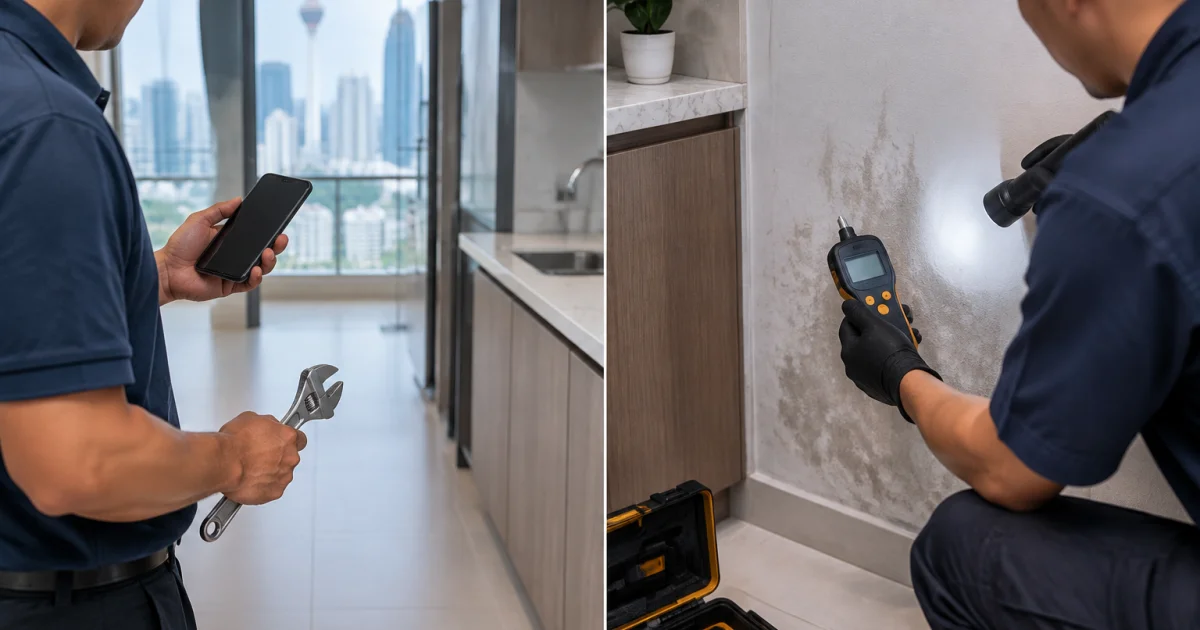
- On-site observation of symptoms: stains, damp corners, cabinet bases, skirting swelling, odour, mould patterns.
- Basic isolation testing where possible: run shower, flush WC, fill basin, run washing machine discharge, check A/C drain discharge.
- Targeted checks of likely failure points: traps, joints, flexible hoses, stop valves, floor traps, pipe penetrations, failed sealant lines.
- A written summary of likely cause(s), next steps, and what needs access/hacking (if any).
What should raise your eyebrows
- Diagnosis is proposed, but no testing plan is explained.
- The contractor can’t tell you what they’re trying to rule out.
- They immediately jump to a large scope (full bathroom hacking, full replumbing) without narrowing possibilities.
- They promise certainty for a complex issue in minutes. Hidden leaks don’t work that way.
A simple comparison table: fixed-price vs diagnosis-first (how to choose)
| Decision factor | Fixed-price quote is best when… | Diagnosis-first visit is best when… |
|---|---|---|
| Leak visibility | You can point to an active drip at an accessible fitting | The leak is behind tiles, walls, ceiling, or travels from another area |
| Trigger pattern | Always leaks the same way (e.g., tap turned on = drip appears) | Only happens sometimes, after certain usage, or appears hours later |
| Property type | Landed home with easy access to pipes and valves | Condo/apartment where water can migrate across units/slabs |
| Risk of “wrong fix” | Low: replacing a known faulty part solves the symptom | High: multiple suspects (plumbing, cracks, waterproofing, drainage) |
| Budget control | You want a capped cost for a defined task | You want to avoid paying twice by confirming cause before committing |
| Proof needed | Not critical (single-unit issue, clear fault) | Important (neighbour complaint, management report, recurring damage) |
Common KL scenarios where homeowners misjudge the “best” quote type
1) Condo leak to the unit below: “Just quote to fix my bathroom”
In condos, the fastest way to waste money is to approve a full scope based purely on where the stain appears downstairs. Water can travel along slab edges and pipe routes before it drops. A fixed price to “repair the downstairs ceiling leak” is usually meaningless.
My view: start with diagnosis-first and insist on an isolation approach (shower, basin, WC, floor trap) and a clear suspected source. Only then should you accept a fixed scope for the repair method.
2) Kitchen cabinet base damp: “It’s probably the sink”
Sometimes it is. Sometimes it’s an angle valve seeping slowly, a flexi hose that only leaks under pressure spikes, or even condensation from cold pipes in a humid kitchen. A fixed quote to “reseal the cabinet” can hide the issue while the timber swells and mould grows.
A good diagnosis-first visit here is usually short and decisive: check and test the plumbing components, observe after running water, and confirm if moisture returns when not using the sink.
3) Ceiling stain under a bathroom/pantry: “Just patch the crack”
Cracks matter, but cracks are not always the source. You can have a pipe joint leak that uses a crack as a pathway, or a crack that only shows during rain. When hacking is highly disruptive, some owners ask about injection methods. It can be relevant, but only after plumbing is ruled out.
For example, PU injection waterproofing KL is often discussed when water is travelling through concrete cracks or joints and you want a non-invasive way to block the pathway. However, injection should not be used as a substitute for repairing a leaking pipe. If the source is still feeding water, you are paying to manage symptoms, not the cause.
4) Small business unit (shop lot/office): “Give me a price now, I can’t stop operations”
I understand the urgency. But in commercial spaces, downtime pressure can tempt owners into approving the fastest quote. The smarter compromise is often: a short diagnosis window (scheduled off-peak), then a fixed scope that is staged (night work, partial area access, temporary protection for stock).
How I’d request a quote (so you get a number without guessing)
If you want a contractor to price accurately without overcharging “just in case,” you need to package the problem well. Here’s a practical way to do it:
- State the triggers: rain only, showering, flushing, washing machine, or “no pattern.”
- Share time-based evidence: short videos of dripping, photos right after it happens, and photos when it dries.
- Map the area: which wall, which side of the bathroom, which cabinet corner, which ceiling line.
- List recent changes: renovation, new water heater, new bidet spray, pipe rerouting, new tenant.
- Ask for two numbers: (1) diagnosis fee/scope and deliverables, (2) repair options after diagnosis.
This approach also protects you from “diagnosis creep.” You’re setting expectations: diagnose, document, propose repair scopes. Not diagnose forever.
My bottom line: pick the quote style that matches uncertainty
Fixed-price quotes are not “bad.” They’re efficient when the work is defined. Diagnosis-first visits are not “a trick.” They are the correct engagement model when the cause is uncertain, hidden, or disputed.
If you remember one principle, make it this: the more uncertain the leak source, the more dangerous a fixed quote becomes. Not because the contractor is dishonest, but because reality is. Water travels. Condos amplify that. And repeated repairs cost far more than a proper first diagnosis.
If your issue involves cracks along walls or junctions, don’t let anyone casually label it “just plaster.” A proper wall crack repair service KL scope should explain whether the crack is cosmetic, movement-related, or part of the water pathway—then match the repair method accordingly.
Conclusion
For KL homeowners, condo residents, and small business operators, the smartest plumbing decision is often not “which contractor is cheapest,” but “which engagement model fits my problem.” Use fixed-price for defined, visible faults. Use diagnosis-first when the leak is intermittent, concealed, recurring, or.
Frequently Asked Questions
Is a fixed-price plumbing quote ever a red flag in Kuala Lumpur?
Not by itself. It’s a red flag when the contractor offers a fixed price without asking basic questions (triggers, location, photos) or without seeing the leak area when the source is uncertain. Fixed pricing works best for visible, standard tasks—like replacing a flexi hose or trap—where the scope is truly defined.
What should I ask for during a diagnosis-first plumbing visit?
Ask what they will test and what they are trying to rule out. A good diagnosis-first visit should include symptom inspection, simple isolation testing (shower, flush, basin, sink), checks of common failure points, and a short written summary of the likely leak source and next repair steps.
How do I avoid paying for “diagnosis” that doesn’t lead to a clear plan?
Agree upfront on deliverables: what tests will be done, what areas will be checked, and what you’ll receive afterward (photos and a written recommendation). If hacking is needed to confirm, ask for a targeted access plan and a repair quote after confirmation, not a vague open-ended arrangement.
My condo neighbour downstairs complains of dripping—should I book plumbing or waterproofing first?
If the timing relates to water usage (shower, flushing, sink), start with plumbing diagnosis. If it worsens mainly during heavy rain or involves external walls/balconies, waterproofing may be involved. In many condo cases, a diagnosis-first visit is the fastest way to isolate the true source before committing to a bigger scope.
When is PU injection relevant for leaks, and when is it the wrong choice?
PU injection can be relevant when water is travelling through concrete cracks or joints and you want a non-invasive way to block the pathway. It’s the wrong choice if a live pipe leak is still feeding water—because injection may temporarily mask symptoms while the plumbing fault continues to cause damage.
Need a clearer plan before you book a plumber in KL?
Cisco Waterproofing supports Kuala Lumpur and Selangor homeowners and building managers with a practical, root-cause-first approach—whether the next step is targeted plumbing work, crack treatment, or leak-stopping methods like PU injection for suitable cases.
If you’re stuck between “give me a fixed quote now” and “we need to diagnose first,” tell us what you’re seeing (photos help). We’ll advise the most sensible engagement approach for your situation.